Cluster API for evroc
The Cluster API for evroc — or CAPE — allows users to easily deploy self-managed Kubernetes clusters on evroc infrastructure.
Cluster API is a Kubernetes project that provides declarative APIs and tooling to simplify provisioning, upgrading, and operating Kubernetes clusters from a management cluster. CAPE is a Cluster API Infrastructure Provider for evroc. CAPE makes it easy to use Cluster API to run Kubernetes on evroc virtual machines.
How it works
As with all Cluster API usage, you begin with an existing "bottom turtle" Kubernetes cluster — known in the Cluster API docs as the management cluster — into which you'll deploy the CAPE infrastructure provider.
How you do this is outlined in steps 1-5 of the "Quick Start" guide in the GitHub README.
Once you've done this, you'll need to create an evroc service account and write its credentials to a secret in this management cluster. This allows CAPE to interact with the evroc API to create virtual machines and other resources. This is outlined in steps 6 and 7 of the Quick Start guide.
Next, you can deploy a Kubernetes cluster using evroc infrastructure. This is done by deploying Cluster resources into the management cluster.
A simplified diagram of how this works is shown below:
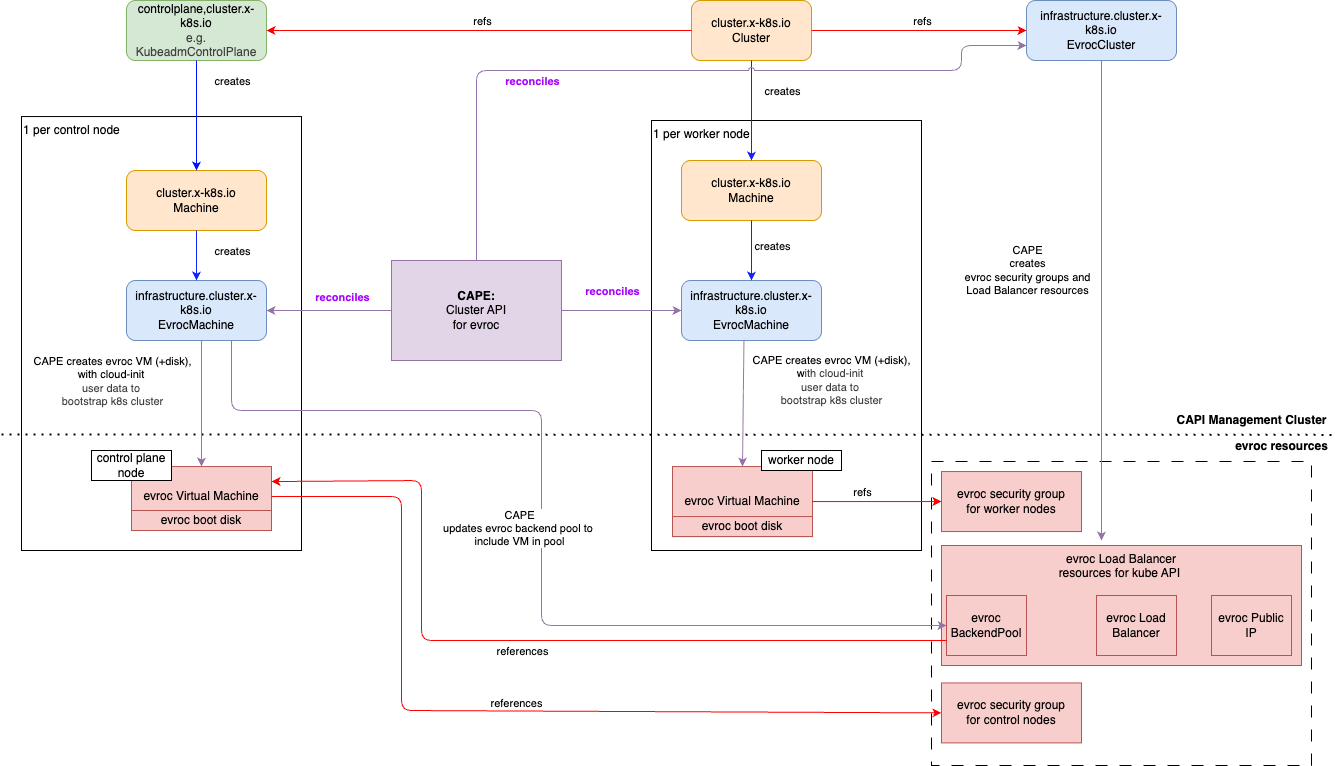
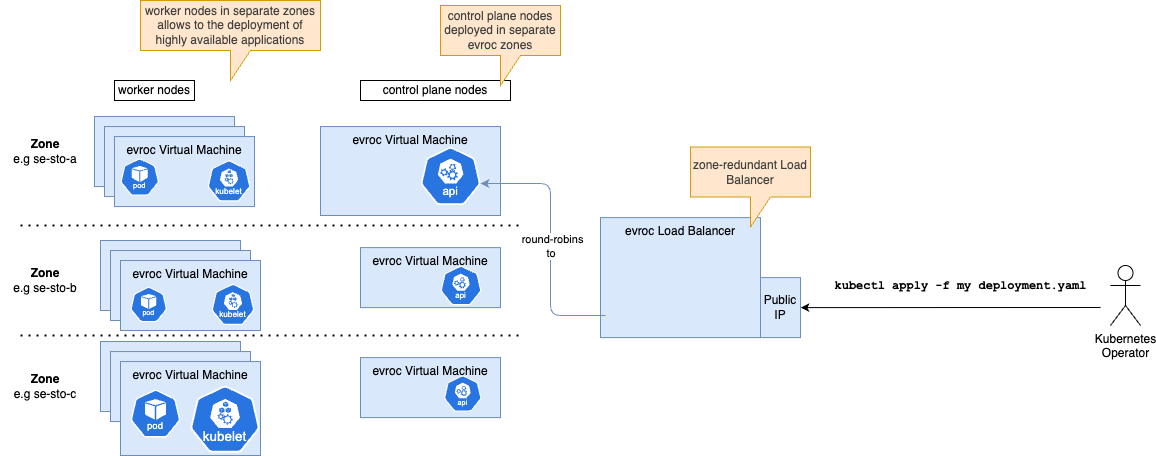
After this, a Kubernetes cluster is deployed on evroc infrastructure, which you can access via the public API it provides. A kubeconfig file is provided as a secret in the management cluster, and tooling such as clusterctl can access this.
Learn more
- CAPE GitHub repository - contains source code, templates, and the Quick Start guide.
- evroc CSI driver - Once you have a Kubernetes cluster deployed, you can deploy a CSI driver on it to dynamically provision persistent block storage using evroc Disks.