Self-managed Kubernetes on evroc
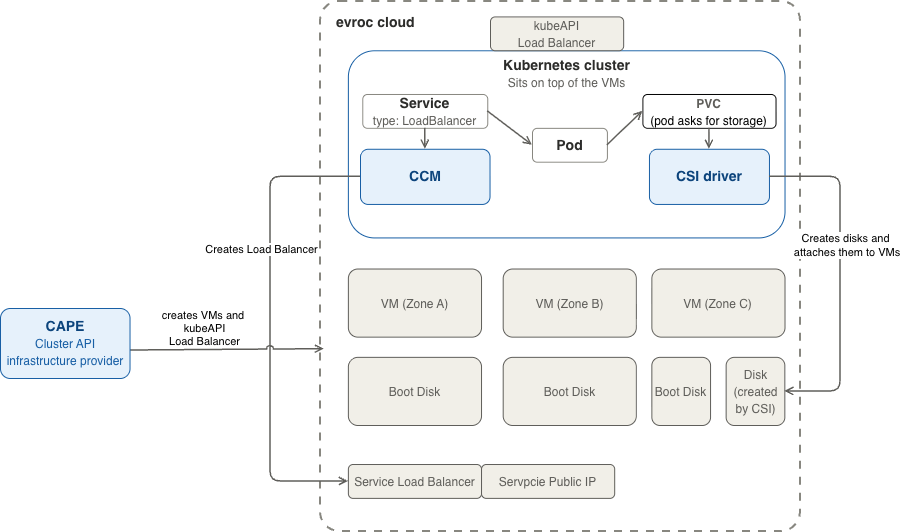
Self-managed Kubernetes on evroc is delivered through three open-source components that each handle one layer of the cloud integration:
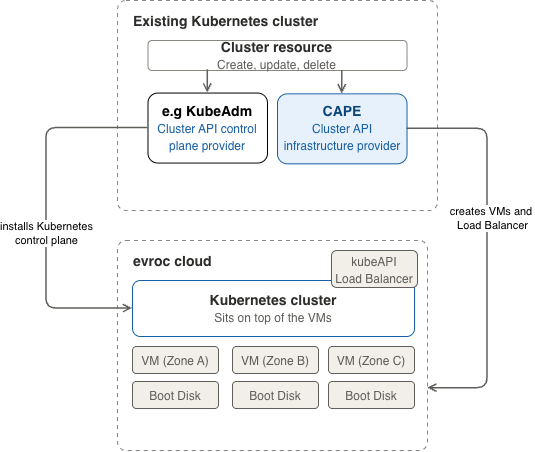
- Cluster API for evroc (CAPE) - provisions and manages the lifecycle of Kubernetes clusters on evroc VMs.
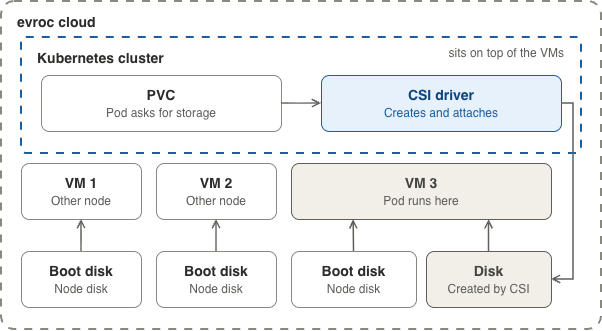
- evroc CSI driver - provides persistent block storage to pods, backed by evroc Disks.
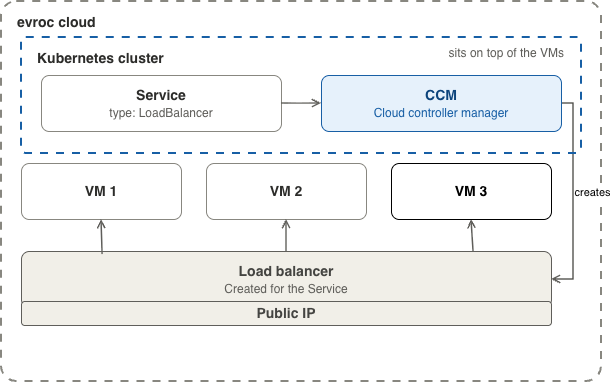
- evroc Cloud Controller Manager (CCM) - integrates evroc load balancers and public IPs with Kubernetes, and manages node lifecycle.
Use these components together for a fully integrated Kubernetes cluster on evroc, or adopt just the layer you need: provisioning, storage, or load balancing.
How the components fit together
The three components cover the standard Kubernetes cloud-integration surface. CAPE creates the VMs and bootstraps the cluster. Once the cluster is running, the CCM initializes each node (labels, addresses, provider ID) and backs type: LoadBalancer services with evroc load balancers and public IPs. The CSI driver provides persistent volumes backed by evroc Disks.
CAPE provisions a Kubernetes cluster from a management cluster:
The CCM bridges the cluster and the evroc load balancer and public IP services:
The CSI driver provisions and attaches evroc Disks to pods:
Next Steps
To deploy a cluster end-to-end, see Deploy a self-managed cluster.
Note: Each component authenticates to the evroc API using its own evroc service account. CAPE uses an evroc service account with compute and networking permissions, while the CSI driver and CCM use the
kubernetesCSIAgentandkubernetesCCMAgentroles respectively. See each component's page for credential setup details.